Showing posts with label technology sharing. Show all posts

Monday, October 24, 2011

Leon FITS Center hosts WVSU TG cross-visitors

By Van Kristine Mendoza

Representative

Regional Applied Communications Group

West Visayas State University


The Farmers’ Information and Technology Services (FITS) Center based in Leon, Iloilo recently hosted some 25 representatives of the Techno Gabay (TG) Team from the West Visayas State University (WVSU) at the Leon FITS Center Hall in Poblacion, Leon, Iloilo. The visiting team consisted of managers and staff of WVSU’s member FITS Centers, their Magsasaka Siyentista (MS) and representatives from the WVSU, their partner member agency.


“We may be a new FITS Center but we are working hard to build our image,” Municipal Agriculturist Magdalena Capilastique said in her speech.


For his part, Leon Mayor Rolito Cajilig said that the changing climate and the environmental crises pose threats to the farmers, the town’s major sector. According to Cajilig, Leon is an agricultural highland. Only ten percent of its 14,000 hectares is flat. Farming is Leon’s primary livelihood. Of the 85 barangays, 68 are prone to floods, landslide and calamities. “We have no choice but fight poverty,” Cajilig said. Because the town draws income from farming, Mayor Rolito Cajilig supports efforts related to it.


The local government of Leon has also been promoting Bucari, a forested area 24 kilometers from the poblacion which can serve as an eco- or agri-tourism site. Leon has also been marketing organic vegetables and its “super mangoes.” According Leon FITS Center Manager Feljean Cagape, their produce are called super mangoes because they are much sweeter than any mangoes in Panay.


Leon mangoes are found to have higher fructose content than the Guimaras mangoes. Their sweet taste is attributed to the town’s soil condition and topography. Cagape said that Leon’s soil salinity is much lower than that of Guimaras.


As part of the One Town, One Product (OTOP) program of Leon, mangoes are promoted by local government in their own community. Couples asking to be married by the mayor are asked to bring a mango seedling to the ceremony. All coupled wed by the local government are required to plant the mangoes and cultivate them in their households.


At the end of the welcome program, the cross-visitors were hosted to a vegetable greenhouse located in the municipality.


A DAY IN THE FARM (see above photo). The WVSU Techno Gabay team visits a vegetable farm in their first Cross-Visit to the Leon FITS Center in Leon, Iloilo. As part of the WESVARRDEC culture, study tours such as this serve not only as avenues for information and knowledge sharing but also monitoring mechanism for the consortium.

Thursday, September 15, 2011

Batad FITS Center hosts 2nd corn congress

By Sally R. Villasis

Representative

Regional Applied Communications Group

Aklan State University


To showcase the technology on open-pollinated corn varieties (OPV), the Farmers Information and Technology Services (FITS) Center based in the Northern Iloilo Polytechnic State College (NIPSC) Batad Campus in Batad, Iloilo led the Second Municipal Corn Congress and Corn Derby on September 5, 2011 at NIPSC Batad Campus in Batad, Iloilo.


The congress convened some 300 participants composed of farmers, teachers, students, stakeholders of the corn industry, representatives of Western Visayas Agriculture and Resources Research and Development Consortium (WESVARRDEC); representatives of seed technology, pesticides and fertilizer companies; government officials in Batad, Iloilo and environs.


Anchored on the theme “Responsable kag Mapadinayunon nga Pagpanguma, Mauswagon nga Banwa,” the congress aimed to encourage farmers and other stakeholders to adopt the OPV technology and natural farming system to increase their corn production and income. With the corn summit this year, the organizers likewise sough to conduct research trials to produce technologies that can be shared with farmers.


In his opening speech, Mr. Ricardo Ayupan, NIPSC Batad’s college administrator, said that crop productivity and food self-sufficiency today can help stop hunger and alleviate poverty.


NIPSC led the corn summit to initiate the sharing of the R&D experience and disseminate its enormous potential not only for Batad but for also for the Western Visayas. Farmers were also urged to maximize and reduce the cost of production and the integration of bio-organic fertilizer.


For his part, Dr. Joel Limson, president of the NIPSC System, stressed that “our country is being struck by two major concerns—how to increase production, and how to protect the environment, both of which seem difficult to achieve.” According to Limson, there is a need to strike a balance between the increasing population and the dwindling resources and production.


Prof. Eva Montero, FITS manager and associate director for research and development, said that they also hosted the first corn congress in 2010. There they found that farmers need to know more information particularly on the importance of nurturing the environment. Therefore, Batad FITS Center coordinated with the National Research Center for Corn to develop the OPV technology. Montero said they were able to produce the seeds during the last cropping. For this current cropping, they conducted weed control trial and major pest survey on corn OPV at a 1.6 hectare corn techno-demo research farm in NIPSC Batad. The efforts were backed by the local government of Batad, NIPSC Batad, and the Agricultural Training Institute-RTC 6 as partner member agency.


Meanwhile, Mr. Ricardo Saltin, corn program coordinator of the Department of Agriculture (DA)-Regional Field Unit 6, said that besides promoting white corn, especially in sloping areas, DA has provided post-harvest facilities to support the corn farmers.


Dr. Anna Mae Relingo, Regional Techno Gabay (RTG) coordinator of WESVARRDEC and officer-in-charge of the Office of the Vice-President for Research and Extension of Aklan State University (ASU), enjoined the participants of the economic value of corn not only for human consumption or feeds but for other purposes. Relingo said that various corn products have been promoted by the consortium during regional and national techno fairs, and they usually stand out.


The corn congress featured technology forums on the practice of site-specific nutrient management and the effects of different fertility practices on OPV Maize.


Then, to promote value-addition for the corn as commodity, the organizers hosted a Corn Dish Cooking Contest for Bachelor of Science in hotel and Restaurant Management (BSHRM) students of NIPSC. In the said contest, the Prawns in Corn Pandan Curry Sauce by Warren Castañares and Fritz Bornales, second-year students won the top prize; while the Stuffed Squid with Corn Sauce by freshman Jerome Tullo and the Pan Roasted Chicken with Creamy Corn Garlic Gravy by sophomore Shisan Charm Balete and junior Ronald Balete.


Wednesday, September 07, 2011

Meet MS Job Aranda, the coconut farmer


By Van Kristine Mendoza
Representative
Regional Applied Communications Group (RACG)
West Visayas State University

MS Job Aranda
Venturing into the coconut industry is hard but it gives enormous rewards to the hard worker.

This has been proven true by Mr. Job T. Aranda, Magsasaka Siyentista (MS) of the Farmers Information and Technology Services (FITS) Center based in Tubungan, Iloilo.

On August 16, 2011, through the coordination of West Visayas State University with the Philippine Council for Agriculture, Forestry and Natural Resources Research and Development (PCARRD) who gave the grant, MS Aranda hosted the Science and Technology-Based Farm (STBF) on Coconut Field Day in his two-hectare coconut plantation at Sitio Durog, Lanag Sur in Tubungan, Iloilo.

Aranda’s coconut field day gathered the farmers from the barangays of Tubungan, Iloilo and representatives of the Western Visayas Agriculture and Resources Research and Development Consortium (WESVARRDEC).

Supported by the officials of the Municipality of Tubungan and staff of WVSU University Research and Development Center (URDC), MS Aranda’s Field Day featured a program about the Coconut Science and Technology-Based Farm Project and tour of the coco coir factory.


In his speech, Tubungan Mayor Vicente Gargaritano, Jr. said “People want to see first in order to believe. We are all here so others can replicate and practice the technologies that our MS has been doing.”

The STBF Field Day is designed to promote the benefits of science and technology to the farmers and demonstrate the interventions by the MS in his farm.

Under the STBF grant, MS Aranda introduced a number of interventions to rehabilitate his coconut farm. First, to clear the entire plantation, Aranda sought to get rid of rats in his coconut trees by cutting off the branches where they pass from one tree to another. Second, Aranda employed ring weeding and applied fertilizer. Aranda used salt and urea as fertilizer and asked other farmers to do the same three times a year. Third, he made sure that the rat guard is installed and a perimeter fence is constructed. Fourth, he planted ampalaya, camote, peanuts, and eggplant between the coconut trees to facilitate intercropping. Next, he made sure that irrigation of the intercrop and coconut trees are properly built. And finally, he moved to practice pest control which included getting rid of beetle rhinoceros.


After his retirement from Bangko Sentral ng Pilipinas, MS Aranda ventured into farming in 2003. In 2007, he was chosen MS for coconut of Tubungan FITS Center. He helped establish a cooperative to build and operate a coco fiber factory. Because of his efforts and involvement in the coconut industry, he was awarded by the Iloilo Provincial Government Outstanding Coconut Farmer in 2009.

However, just like the biblical character Job, his namesake, MS Aranda had his share of difficulty. In 2009, Aranda said, “we were deprived of things beyond our control because of the El Niño Phenomenon. I could not apply fertilizer to his crops because the heat was just too much.” Add to the high temperature the increasing number of unproductive trees in his farm.

But he did not easily give in. Consequently, Aranda increased production from 30 nuts to 140 nuts or trees per year. He did not only maximize land use by intercropping with vegetables but also increased raw materials for coco fiber production and provided appropriate technologies to other coconut farmers. He also helped provide livelihood for mothers working in the coco coir factory and thereby helped increase farm income.

At the Iloilo Horti 2010, coco coir products from
FITS Tubungan were featured by WESVARRDEC.
Just like the ideal farmer scientist, MS Aranda takes part in various forums and trainings in coconut production together with other stakeholders in the coconut industry. In these opportunities, his knowledge is also enhanced. Through the years of engaging into coconut production, MS Aranda’s farm has become a venue for farm research and cross visits by other MS, farmers, students, and agricultural technicians.

“Farming is simply my passion,” MS Aranda says.

Aside from the coconut plantation, Aranda also farms five hectares of rice land. And perhaps not content to rest on his laurels, the tireless farmer practitioner even hopes to engage into Darag native chicken industry in the future.

Monday, September 05, 2011

Collaborations rule WESVARRDEC’s 2011 R&D symposium


By Isaac Abello, Regional Applied Communications Group (RACG) Staff
With reports from Niño Manaog, University Extension Associate, Capiz State University

This is the year of collaboration and group effort.

In the 21st Regional Symposium on Research and Development Highlights (RSRDH) hosted by the Western Visayas Agriculture and Resources Research and Development Consortium (WESVARRDEC) on August 26, 2011 at the Henry Luce III Library of the Central Philippine University (CPU) in Jaro, Iloilo City, all winning papers consisted of co-authorships from faculty and researchers of some eight partner member agencies (PMAs) across the region.

Winning presenters were (from top)
Dr. Greta Gabinete of WVSU,
Ms. Nenita Sodusta of DA-WESVIARC
and Prof. Arlene de la Cruz of ASU.
Of the 17 research papers presented, the “Development of Site-Specific Nutrient Management (SSNM) Recommendations for Irrigated Rice in Region VI” authored by Greta Gabinete, Hector Peñaranda, Benjamin Gutierrez and Roland Buresh won the first prize. The study was a collaborative effort of the West Visayas State University, (WVSU), the Department of Agriculture-Regional Field Unit 6 (DA-RFU 6), the Capiz State University (CapSU); and the International Rice Research Institute (IRRI).

The “Field Testing of ICRISAT Legume Varieties and Technologies in Selected Regions of the Philippines” conducted by Corazon Arroyo and Nenita Sodusta of the Department of Agriculture-Western Visayas Integrated Agricultural Research Center (DA-WESVIARC) won second place; while Aklan State University (ASU)’s “Inventory and Bio-prospecting of Natural Dye-Yielding Plants in the Province of Aklan” by conducted by Lelisa Teodosio, and many others was awarded the third prize.

The research panel of evaluators was composed of Dr. Rolando Labios of the Department of Agriculture-Bureau of Agricultural Statistics (DA-BAR); Dr. Marcelino Siladan of the Philippine Council for Agriculture, Forestry and Natural Resources Research and Development (PCARRD); and Engr. Emelyn Flores of  the Department of Science and Technology (DOST) Region 6.

Among seven papers presented under development, all three presentations by the West Negros College Research and Development Foundation, Inc. (WNC-RDFI) swept the top awards. The top development study titled “Bio Power-up Fuel Additive” presented its benefits to the environment, economy and livelihoods to the users. The second-placer technology “Low-Density Biomass Charcoal Maker” details procedures required in producing charcoal briquettes while their third-place study titled “SPD Multi-function Food Processing Equipment” presented a three-in-one equipment that works as sterilizer-pasteurizer-drier, which is ideal for food processors.

The tandem of Engr. Paolo Petalver (top)
and Engr. Dioscoro Marañon, Jr.
(bottom right) of WNCRDFI produced
impressive technological developments.
The tandem of Engr. Paolo Petalver and Engr. Dioscoro Marañon, Jr. of WNCRDFI who produced such technological developments impressed the panel of the judges consisting of Mr. Ramon Peñalosa, Jr., Magsasaka Siyentista of WESVARRDEC; Engr. Rowen Gelonga, regional executive director of the DOST Region 6; Dr. Juanito Batalon of PCARRD; and Engr. Gilberto Altura of the National Economic and Development Authority (NEDA) Region 6.

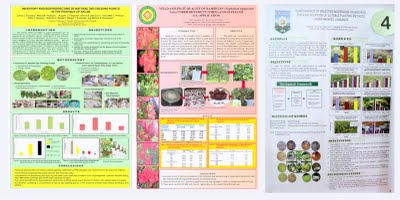
For poster category, Aklan State University’s presentation on “Inventory and Bioprospecting of Natural Dye-Yielding Plants in the Province of Aklan” and the “Yield and Fruit Quality of Rambutan under Different Timing and Levels of GA3 Application” won the first and the second prizes. CapSU’s work on the “Performance of Selected Indigenous Upland Rice through Adoption of Suitable Planting Methods under Rainfed Lowlands” was awarded third.

Winning posters (from left) from ASU and CapSU
Dr. Ma. Luisa Mabunay of the University of the Philippines (UP) Visayas; Dr. Ma. Cielito Siladan of the Forest Products Research  and Development Institute (FPRDI); and Dr. Lilian Diana Parreno of Guimaras State College (GSC) served as poster evaluators.

A number of evaluators were impressed with this year’s R&D outputs. Dr. Juanito Batalon, member of the planning, programming and packaging section of PCARRD’s crop research division, said the development papers, though few, most essentially addressed issues of preserving the environment while seeking to provide livelihoods to people.

Research panel (from left)
Dr. Rolando Labios,
Dr. Marcelino Siladan
and Engr. Flores
Dr. Marcelino Siladan, head of the program planning and packaging section of the Forest and Environment Division (FERD) of PCARRD, said that the winning research papers could very well compete in the national selection.

Among others, MS Ramon Peñalosa, meanwhile, took interest in CapSU’s banana chipper technology presented by Julito Albaladejo. For Peñalosa, such technologies can surely benefit small farmers and backyard technologies.

Most important, Engr. Rowen Gelonga, regional executive director of DOST 6, suggested that prior to their presentations of technologies during symposiums, the consortium should create an ad hoc committee to coordinate for Intellectual Property (IP) rights and issues. According to Gelonga, this is to safeguard the IP rights of inventors and their technologies and inventions.

The winning papers in the R&D categories will compete in the National Symposium on Agriculture and Resources Research and Development (NSARRD) to be hosted by PCARRD-DOST in November this year.


The development panel included (from left) Dr. Gilberto Altura;
MS Ramon Peñalosa, Jr;  Dr. Juanito Batalon
and Engr. Rowen Gelonga.
For his part, incoming Regional Research and Development Coordinating Council (RRDCC) chair, Dr. Joel Limson, president of the Northern Iloilo Polytechnic State College (NISPC) based in Estancia, Iloilo, warmly welcomed the participants in the symposium’s opening rites. Among others, Limson encouraged cooperation and teamwork among member agencies and which will benefit the consortium as a whole.

Hosted by CPU led by Dr. Reynaldo Dusaran, Techno Gabay Team Leader; Dr. Hope Patricio, RACG representative; and Aries Roda Romallosa, Regional Management Information Systems Group (RMISG) representative—this year’s 21st RSRDH was made possible through the efforts and initiative of the Consortium Secretariat and Dr. Geronimo Gregorio of CapSU, Regional Research and Development Group coordinator; Dr. Anna Mae Relingo of ASU, Regional Techno Gabay Group coordinator; Prof. Nilo Araneta of UPV who chaired the tabulation committee; and Dr. Jane Geduspan of UP Visayas and acting director and officer-in-charge of WESVARRDEC.


Participants, officials and facilitators of this year's RSRDH

Friday, August 12, 2011

MS Alemany shares farming practices

By Jethro B. Dagunan

Regional Applied Communications Group Representative

Carlos Hilado Memorial State College


It’s harvest time for Jun.


Years of trial and error in growing off-season cantaloupe melon has given Jose Vicente “Jun” Alemany, Magsasaka Siyentista (MS) of the Farmers Information and Technology Services (FITS) Center based in Escalante City, Negros Occidental the level of knowledge and farming practice he now shares to his fellow farmers.


Alemany’s best practices in vegetable production included in the Science and Technology Based Farm (STBF) of the Escalante FITS Center was recently approved by the Philippine Council for Agriculture, Forestry, Fishery Resources and Research Development (PCARRD). Said project will be monitored by Western Visayas Agriculture and Resources Research and Development Consortium (WESVARRDEC).


Downloaded and coursed through the Carlos Hilado Memorial State College (CHMSC), partner member agency of WESVARRDEC, the STBF Project for MS Alemany will showcase the use of appropriate S&T interventions in off-season production of cantaloupe melon. Aside from promoting the use of S&T based technologies on off-season cantaloupe production to 30 farmers and adopters, the STBF will come with the documentation of the best management practices on the same.


As part of the STBF, MS Alemany started sharing the one-module technology July 12, 2011 in his farm in Alimango, Escalante City, Negros Occidental.


The training is divided in two (2) cycles with 30 farmer beneficiaries. Each cycle will feature one module for eight weeks to benefit 15 farmers in order to ensure quality interactions and learning.


In the first module training, MS Alemany shared his know-how on the good and bad uses or qualities of water. He also made the farmers understand the soil and its pH (alkaline and acidity) level, the importance of both major and minor or trace elements. Alemany also lectured on the proper preparation of plot with plastic mulching, and planting and seedling preparation.


MS Alemany’s technology is promoted by Escalante City FITS Center led by FITS Manager Ferdinand Alico.


Related Posts Plugin for WordPress, Blogger...

Printfriendly