Showing posts with label Western Visayas. Show all posts

Monday, October 17, 2011

WESVARRDEC starts sustainable darag chicken production program

By Isaac Abello

Staff, Regional Applied Communications Group (RACG)

With Reports from Niño Manaog and Bede Ozaraga, Capiz State University


Research in the darag native chicken is now official.


Recently, the Western Visayas Agriculture and Resources Research and Development Consortium (WESVARRDEC), under the auspices of the Philippine Council for Agriculture, Forestry and Natural Resources Research and Development (PCARRD) launched the Development of Sustainable Production System for the Darag Native Chicken (Gallus gallus domesticus) in Western Visayas, a pioneering project that involves the Research and Development arms of four state colleges and universities in the region—West Visayas State University (WVSU), Central Philippine University (CPU), Aklan State University (ASU), and Capiz State University (CapSU).


In an inception meeting held at the Residence Hotel in Iloilo City in August 2011, Dr. Synan Baguio, supervising science research specialist and Dr. Edwin Villar, livestock research division director, both of PCARRD presented to the SUC representatives the terms and conditions of the funded project and the responsibilities of the collaborating agencies. The PCARRD officials likewise briefed the SUCs on the schedule of monitoring and evaluation and the delivery of outputs from the project.


The program will be a collaborative effort of said four SUCs. WVSU will develop a native chicken breeding and hatchery management system that would ensure stable supply of both breeder and slaughter native chickens of predictable performance and consistent quality in commercial quantities.


CPU will develop and establish a feed production and distribution system for free-range native chickens while ASU will establish a Newcastle Disease vaccine production and distribution systems for the same purpose. For its part, CapSU will produce and distribute a stable supply of ethno-botanical antihelmintics and develop a range area (pasture) enhancement protocol for the darag native chickens.


In the same event, WVSU’s Dr. Evelyn Tomambo, who is also the program leader, presented the new program titled “Development of Sustainable Darag Native Chicken (Gallus gallus domesticus) Production System as Climate Change Adaptation Option for the Poultry Industry in Western Visayas.”


Among others, the program will organize information and component technologies generated thru previous research and development into a sustainable enterprise-type native chicken production system. It seeks to usher in productive and profitable utilization of locally available feed, medicinal plants and chicken genetic resources.


According to the program, an organized native chicken production system will help establish sustainable native chicken-based enterprises by rural dwellers and ensure stable supply of good quality native chicken products that meet quality and quantity requirements of institutional buyers and domestic consumers.


Promoted by WESVARRDEC Director Joseph Edward Idemne, the program is supported by ASU President Danilo Abayon, CPU President Teodoro Robles, WVSU President Pablo Subong, Jr., and CapSU President Editha Magallanes as represented by Dr. Geronimo Gregorio, WESVARRDEC’S regional research development group coordinator, and CapSU’s vice-president for research and extension.


Monday, September 05, 2011

Collaborations rule WESVARRDEC’s 2011 R&D symposium


By Isaac Abello, Regional Applied Communications Group (RACG) Staff
With reports from Niño Manaog, University Extension Associate, Capiz State University

This is the year of collaboration and group effort.

In the 21st Regional Symposium on Research and Development Highlights (RSRDH) hosted by the Western Visayas Agriculture and Resources Research and Development Consortium (WESVARRDEC) on August 26, 2011 at the Henry Luce III Library of the Central Philippine University (CPU) in Jaro, Iloilo City, all winning papers consisted of co-authorships from faculty and researchers of some eight partner member agencies (PMAs) across the region.

Winning presenters were (from top)
Dr. Greta Gabinete of WVSU,
Ms. Nenita Sodusta of DA-WESVIARC
and Prof. Arlene de la Cruz of ASU.
Of the 17 research papers presented, the “Development of Site-Specific Nutrient Management (SSNM) Recommendations for Irrigated Rice in Region VI” authored by Greta Gabinete, Hector Peñaranda, Benjamin Gutierrez and Roland Buresh won the first prize. The study was a collaborative effort of the West Visayas State University, (WVSU), the Department of Agriculture-Regional Field Unit 6 (DA-RFU 6), the Capiz State University (CapSU); and the International Rice Research Institute (IRRI).

The “Field Testing of ICRISAT Legume Varieties and Technologies in Selected Regions of the Philippines” conducted by Corazon Arroyo and Nenita Sodusta of the Department of Agriculture-Western Visayas Integrated Agricultural Research Center (DA-WESVIARC) won second place; while Aklan State University (ASU)’s “Inventory and Bio-prospecting of Natural Dye-Yielding Plants in the Province of Aklan” by conducted by Lelisa Teodosio, and many others was awarded the third prize.

The research panel of evaluators was composed of Dr. Rolando Labios of the Department of Agriculture-Bureau of Agricultural Statistics (DA-BAR); Dr. Marcelino Siladan of the Philippine Council for Agriculture, Forestry and Natural Resources Research and Development (PCARRD); and Engr. Emelyn Flores of  the Department of Science and Technology (DOST) Region 6.

Among seven papers presented under development, all three presentations by the West Negros College Research and Development Foundation, Inc. (WNC-RDFI) swept the top awards. The top development study titled “Bio Power-up Fuel Additive” presented its benefits to the environment, economy and livelihoods to the users. The second-placer technology “Low-Density Biomass Charcoal Maker” details procedures required in producing charcoal briquettes while their third-place study titled “SPD Multi-function Food Processing Equipment” presented a three-in-one equipment that works as sterilizer-pasteurizer-drier, which is ideal for food processors.

The tandem of Engr. Paolo Petalver (top)
and Engr. Dioscoro Marañon, Jr.
(bottom right) of WNCRDFI produced
impressive technological developments.
The tandem of Engr. Paolo Petalver and Engr. Dioscoro Marañon, Jr. of WNCRDFI who produced such technological developments impressed the panel of the judges consisting of Mr. Ramon Peñalosa, Jr., Magsasaka Siyentista of WESVARRDEC; Engr. Rowen Gelonga, regional executive director of the DOST Region 6; Dr. Juanito Batalon of PCARRD; and Engr. Gilberto Altura of the National Economic and Development Authority (NEDA) Region 6.

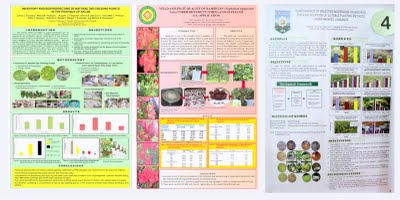
For poster category, Aklan State University’s presentation on “Inventory and Bioprospecting of Natural Dye-Yielding Plants in the Province of Aklan” and the “Yield and Fruit Quality of Rambutan under Different Timing and Levels of GA3 Application” won the first and the second prizes. CapSU’s work on the “Performance of Selected Indigenous Upland Rice through Adoption of Suitable Planting Methods under Rainfed Lowlands” was awarded third.

Winning posters (from left) from ASU and CapSU
Dr. Ma. Luisa Mabunay of the University of the Philippines (UP) Visayas; Dr. Ma. Cielito Siladan of the Forest Products Research  and Development Institute (FPRDI); and Dr. Lilian Diana Parreno of Guimaras State College (GSC) served as poster evaluators.

A number of evaluators were impressed with this year’s R&D outputs. Dr. Juanito Batalon, member of the planning, programming and packaging section of PCARRD’s crop research division, said the development papers, though few, most essentially addressed issues of preserving the environment while seeking to provide livelihoods to people.

Research panel (from left)
Dr. Rolando Labios,
Dr. Marcelino Siladan
and Engr. Flores
Dr. Marcelino Siladan, head of the program planning and packaging section of the Forest and Environment Division (FERD) of PCARRD, said that the winning research papers could very well compete in the national selection.

Among others, MS Ramon Peñalosa, meanwhile, took interest in CapSU’s banana chipper technology presented by Julito Albaladejo. For Peñalosa, such technologies can surely benefit small farmers and backyard technologies.

Most important, Engr. Rowen Gelonga, regional executive director of DOST 6, suggested that prior to their presentations of technologies during symposiums, the consortium should create an ad hoc committee to coordinate for Intellectual Property (IP) rights and issues. According to Gelonga, this is to safeguard the IP rights of inventors and their technologies and inventions.

The winning papers in the R&D categories will compete in the National Symposium on Agriculture and Resources Research and Development (NSARRD) to be hosted by PCARRD-DOST in November this year.


The development panel included (from left) Dr. Gilberto Altura;
MS Ramon Peñalosa, Jr;  Dr. Juanito Batalon
and Engr. Rowen Gelonga.
For his part, incoming Regional Research and Development Coordinating Council (RRDCC) chair, Dr. Joel Limson, president of the Northern Iloilo Polytechnic State College (NISPC) based in Estancia, Iloilo, warmly welcomed the participants in the symposium’s opening rites. Among others, Limson encouraged cooperation and teamwork among member agencies and which will benefit the consortium as a whole.

Hosted by CPU led by Dr. Reynaldo Dusaran, Techno Gabay Team Leader; Dr. Hope Patricio, RACG representative; and Aries Roda Romallosa, Regional Management Information Systems Group (RMISG) representative—this year’s 21st RSRDH was made possible through the efforts and initiative of the Consortium Secretariat and Dr. Geronimo Gregorio of CapSU, Regional Research and Development Group coordinator; Dr. Anna Mae Relingo of ASU, Regional Techno Gabay Group coordinator; Prof. Nilo Araneta of UPV who chaired the tabulation committee; and Dr. Jane Geduspan of UP Visayas and acting director and officer-in-charge of WESVARRDEC.


Participants, officials and facilitators of this year's RSRDH

Sunday, August 28, 2011

ASU hosts Visayas-wide forum on SUCs-private sector partnerships

By Sally R. Villasis

With reports from Rhea V. Martesano


The Aklan State University (ASU) hosted the Forum on SUCs (State Universities and Colleges)-Private Partnership on Education Economic Zones on August 17–19, 2011 at the ASU Review Center in Banga, Aklan.


The first in a series of four, the forum convened presidents, vice-presidents for academic affairs, vice-presidents for research and extension, vice-presidents for production and business of the SUCs and industry representatives from the three regions 6, 7 and 8, all of Visayas.


Led by the Commission on Higher Education (CHED) and the Philippine Association of State Universities and Colleges (PASUC), the said forum sought to provide venue for sharing the best practices on SUCs-Private Partnership and exploring potential partnerships with the private sector.


In his keynote address, Mr. Oscar A. Torralba, chair of the agri-business countryside development committee of the Management Association of the Philippines and CHED’s Technical Panel for Business and Management, presented the salient points of the Economic Education Zones (EEZ) as a Platform for Government-Industry-Academe (GIA) Public-Private Partnerships (PPP) among SUCs.


According to Torralba, SUCs today face intense competition for opportunities and priorities in fiscal allocation with threats of budget deficits and increasing demands by the globalized market. Therefore, it is imperative for SUCs to employ “innovative approaches in facing these harsh realities.” It was in this vein that EEZ was conceptualized.


EEZ is designed to transform an SUC from being traditional, budget-based and grant-driven into an enterprising institution which effectively exploits its natural resource endowments. Under the same approach, SUCs are encouraged to engage in the commercial application of their research and knowledge base and the strong participation of the private sector for long-term cooperation.


For her part, Dr. Virginia Resurreccion, director of CHED’s Regional Office 6, stressed on the importance of raising the country’s human capital to help address the global issue on poverty. For Resurreccion, there is a need for a curriculum that offers quality education and training of students who can compete in the global market and whose skills and expertise can match the emerging trends in the industry.


While these can be hindered by lack of economic resources or similar financial constraints, public and private partnerships can provide key mechanisms for flexibility and accommodate growth in SUCs. For one, newly conceptualized SUC curriculums could help create jobs and help spur economic growth.


According to Resurreccion, partnerships that can be forged between SUCs and private sectors can inspire SUCs themselves to focus on research, training and development. All these efforts can provide inexpensive offshoots to the growth of knowledge economy. Furthermore, partnering with the private sector can help address the need for financial support for SUCs’ R&D activities.


The Visayas-wide forum featured paper presentations on curricular enrichment and development, enterprise development, intellectual property management, technology business incubation and technology commercialization, business process outsourcing and infrastructure and physical facilities development.


ASU reaps awards in 21st R&D symposium

By Sally R. Villasis

Representative

Regional Applied Communications Group

Aklan State University


Three research studies of Aklan State University (ASU) won the top prizes in the 21st Regional Symposium on Research and Development Highlights (RSRDH) led by the Western Visayas Agriculture and Resources Research and Development Consortium (WESVARRDEC) on August 22, 2011 at the Central Philippine University in Iloilo City.


The “Inventory and Bioprospecting of Natural Dye-Yielding Plants in the Province of Aklan” won the top spot in the poster category and third place in the research category. The study was a joint effort of Lelisa Teodosio, Malco Teodosio, Rogelio Felizardo, Arlene dela Cruz, Anna Mae Relingo, Edito Agustin, Roberto Saladar, Margie Sumanga and Marilyn Romaquin of said university. Meanwhile, the “Yield and Fruit Quality of Rambutan under Different Timing and Levels of GA3 Application” by Marilyn Romaquin, Michael Ibisate and Eva Orlina won second in the poster category.


Collaborators of the winning research paper
share the award and recognition for ASU.


Other papers presented in the symposium were the “Inventory on Mangrove-associated Mollusks, Fish and Crustacean Species in ASU-CFMS Reforested Project at Isla Kapispisan, Pinamuk-an, New Washington, Aklan” authored by Regvil de Jose, Eduardo Pastrana and Ryan Basina, and “Sensory Evaluation of Processed Nipa Fruit for Product Development” conducted by Perlita Israel, Rino Andro Inocencio and Marivel Villorente.


Designed to provide venues for discussion of R&D projects and activities in the region and promote collaboration among its member agencies, WESVARRDEC’s 21st RSRDH sought to evaluate researches conducted by the different member agencies and promote interaction between and among


Award-winning posters from ASU

Saturday, August 27, 2011

21st RSRDH Winners

Winners in the 21st Regional Symposium on Research and Development Highlights

Henry Luce III Library, Central Philippine University, Jaro, Iloilo City

22 August 2011


RESEARCH CATEGORY


First Place

Development of Site-Specific Nutrient Management (SSNM) Recommendations for Irrigated Rice in Region VI by Greta Gabinete, Hector Pe
ñaranda, Benjamin Gutierrez and Roland Buresh


Second Place

Field Testing of ICRISAT Legume Varieties and Technologies in Selected Regions of the Philippines by Corazon Arroyo and Nenita Sodusta, Department of Agriculture-Western Visayas Integrated Agricultural Research Center


Third Place

Inventory and Bio-prospecting of Natural Dye-Yielding Plants in the Province of Aklan by Marilyn Romaquin, Lelisa Teodosio, et.al., Aklan State University


Evaluators

Dr. Rolando Labios, DA-BAR

Dr. Marcelino Siladan, PCARRD

Engr. Emelyn Flores, DOST 6


DEVELOPMENT CATEGORY


First Place

Bio Power-up Fuel Additive by Paolo Petalver and Dioscoro Marañon, Jr. of West Negros College-Research and Development Foundation, Inc.


Second Place

Low-Density Biomass Charcoal Maker by Paolo Petalver and Dioscoro Marañon, Jr. of West Negros College-Research and Development Foundation, Inc.


Third Place

SPD Multi-function Food Processing Equipment by Paolo Petalver and Dioscoro Mara
ñon, Jr. of West Negros College-Research and Development Foundation, Inc.

Evaluators

Mr. Ramon Peñalosa, Jr., MS, WESVARRDEC

Engr. Rowen Gelonga, DOST 6

Dr. Juanito Batalon, PCARRD

Engr. Gilberto Altura, NEDA 6


POSTER CATEGORY


First Place

Inventory and Bioprospecting of Natural Dye-Yielding Plants in the Province of Aklan, Aklan State University


Second Place

Yield and Fruit Quality of Rambutan under Different Timing and Levels of GA3 Application, Aklan State University


Third Place

Performance of Selected Indigenous Upland Rice through Adoption of Suitable Planting Methods under Rainfed Lowlands, Capiz State University


Evaluators

Dr. Ma. Luisa Mabunay, UP Visayas

Dr. Ma. Cielito Siladan, FPRDI

Ms. Lilian Diana Parreño, GSC


Thursday, July 21, 2011

Publish more articles, RACG reps urged

By Van Kristine Mendoza

Representative

Regional Applied Communication Group

West Visayas State University


“Write more articles on activities from your own agencies,” Dr. Cora Navarra of the Capiz State University (CapSU), coordinator of Regional Applied Communication Group (RACG) of the WESVARRDEC urged the representatives to submit more articles and have them published on several media.


The RACG coordinator made the pronouncement before RACG representatives of the consortium’s partner member agencies during their second Quarterly Meeting on July 7, 2011 at the Dumalag FITS Center in Poblacion, Dumalag, Capiz. said that over 40 articles were written by WESVARRDEC’s RACG and staff in the first two quarters of the year. Said articles were posted on wesvarrdec.blogspot.com, a blogsite maintained by RACG and on wesvarrdec.org, a web portal updated by the Regional Management Information Systems Group (RMISG) led by Nilo Araneta of UP Visayas.


Most of these articles were picked up by the PCARRD portal maintained by the Applied Communication Division (ACD) headed by Director Lily Ann Lando and were also published by Panay News, an Iloilo City-based daily broadsheet with national circulation.


Bisan ano nga activity or event sa inyo agency o sang inyo mangin maayo nga balita (Any activity or event in your agency or your MS that is well packaged becomes news worthy of publication),” Navarra said.


According to Navarra, RACG even needs to beef up the production of articles because the impact of the articles has been overwhelmingly beneficial in promoting the products of the region’s farmer scientists and FITS Centers. The more articles, the better the promotion, Navarra said.


Prolific publication of said articles has also helped the consortium because it promotes the activities of Magsasaka Siyentista (MS) through media exposure. For one, the McNester products, particularly the mango ketchup and mango sauce, of MS Rebecca Tubongbanua of FITS OPA Guimaras have received more orders from local and foreign buyers owing to the worldwide publicity afforded to the said farmer scientist.


“Manami gid kung ma-interview kag ma-package ninyo ang inyong Magsasakang Siyentista through articles para ma-replicate man sang iban sang ila technology nga ginagamit, (It would be best if you could personally interview your MS and their technologies and write about them so others could replicate these technologies,” Navarra said, citing that if at all, the consortium’s MS need all possible media coverage that they can get.


According to Navarra, some of the published articles will be included in The WESVARRDEC Monitor, the consortium’s publication published twice a year.


The WESVARRDEC RACG led by Coordinator Cora Navarra
of Capiz State University (seated, second from left) held their
meeting at the Dumalag FITS Center under the leadership of
Manager Ronelyn de Tomas (seated, third from left).


Tuesday, July 05, 2011

CapSU Dayao leads mangrove reforestation drive in Talon, Roxas City

By Joselito Sitjar

Extension Chairperson

CapSU Dayao


In support of its ongoing Mangrove Reforestation Project launched in September last year, the Capiz State University (CapSU) Dayao Campus through its Fishery department led the mangrove trees planting in barangay Talon, Roxas City recently.


TROPANG KATUNGGAN
Fishery majors of Capiz State University Dayao Campus
take part in this reforestation drive, which also
inspires others to do something for Mother Nature.

The CapSU Dayao team led by Prof. Domingo Allanic, Prof. Joselito Sitjar, Prof. Pascasio Reyes and Prof. Eddie Tupaz spearheaded the planting of mangrove trees along the shoreline of the said barangay. Some 20 Talon barangay officials and barangay folk and the Fishery students representing all levels of CapSU Dayao took part in the initiative.


According to Mr. Domingo Allanic, mangrove reforestation coordinator of CapSU Dayao, the initiative has been launched to create awareness and promote environmental protection of the people of barangay Talon, its neighboring community. The mangrove seedlings used for the reforestation drive were propagated at the mangrove nursery of CapSU Dayao.


Allanic said that all these steps to continued mangrove reforestation of the Talon shoreline are sought to help create or restore the fish’s natural habitat in the area, which could later help establish it as an eco-tourism site.


For her part, Dr. Lucy Beluso, CapSU Dayao campus administrator, said this and other similar initiatives virtually form part of the campus’s flagship advocacy to reach out to the fishing communities to help improve the livelihood of its constituents.


A participant takes the first step in reforesting the mangrove area in barangay Talon.

Related Posts Plugin for WordPress, Blogger...

Printfriendly