Showing posts with label research. Show all posts

Tuesday, September 09, 2014

WESVARRDEC conducts Training-Workshop on Experimental Statistics

by Christy Amular
WESVARRDEC Staff 


Agriculture, forestry and natural resources (AFNR) researchers of  WESVARRDEC's consortium member agencies (CMAs) underwent a two-day training workshop on Experimental Statistics sponsored by the Grants-in-Aid (GIA) Program of the Department of Science and Technology Regional Office VI last  August 27-28, 2014 at the Center for Teaching Excellence in West  Visayas State University. The training is part of WESVARRDEC's  strategic goal of upgrading the competencies  of researchers and research managers in priority fields.

About forty participants from various CMAs  were trained on the use of Statistical Tool for Agricultural Research (STAR), a computer program for data management  and basic statistical analysis of experimental data. Designed for crop scientists, its graphical interface was created using the Eclipse Rich Client Platform  (RCP) and R language and environment for statistical computing and graphics. Its current  version provides modules for generating randomization and layout of experimental designs commonly used in crop research, data management and basic statistical analysis, including descriptive statistics, hypothesis testing, and ANOVA of designed experiments. 

Dr. Roel A. Alli, Faculty of the College of Agriculture and Forestry (WVSU Lambunao Campus)   served as key expert/resource person during the training while Dr. Greta Gabinete, WESVARRDEC's Regional Research and Development Group Coordinator served as workshop facilitator.

Monday, September 05, 2011

Collaborations rule WESVARRDEC’s 2011 R&D symposium


By Isaac Abello, Regional Applied Communications Group (RACG) Staff
With reports from Niño Manaog, University Extension Associate, Capiz State University

This is the year of collaboration and group effort.

In the 21st Regional Symposium on Research and Development Highlights (RSRDH) hosted by the Western Visayas Agriculture and Resources Research and Development Consortium (WESVARRDEC) on August 26, 2011 at the Henry Luce III Library of the Central Philippine University (CPU) in Jaro, Iloilo City, all winning papers consisted of co-authorships from faculty and researchers of some eight partner member agencies (PMAs) across the region.

Winning presenters were (from top)
Dr. Greta Gabinete of WVSU,
Ms. Nenita Sodusta of DA-WESVIARC
and Prof. Arlene de la Cruz of ASU.
Of the 17 research papers presented, the “Development of Site-Specific Nutrient Management (SSNM) Recommendations for Irrigated Rice in Region VI” authored by Greta Gabinete, Hector Peñaranda, Benjamin Gutierrez and Roland Buresh won the first prize. The study was a collaborative effort of the West Visayas State University, (WVSU), the Department of Agriculture-Regional Field Unit 6 (DA-RFU 6), the Capiz State University (CapSU); and the International Rice Research Institute (IRRI).

The “Field Testing of ICRISAT Legume Varieties and Technologies in Selected Regions of the Philippines” conducted by Corazon Arroyo and Nenita Sodusta of the Department of Agriculture-Western Visayas Integrated Agricultural Research Center (DA-WESVIARC) won second place; while Aklan State University (ASU)’s “Inventory and Bio-prospecting of Natural Dye-Yielding Plants in the Province of Aklan” by conducted by Lelisa Teodosio, and many others was awarded the third prize.

The research panel of evaluators was composed of Dr. Rolando Labios of the Department of Agriculture-Bureau of Agricultural Statistics (DA-BAR); Dr. Marcelino Siladan of the Philippine Council for Agriculture, Forestry and Natural Resources Research and Development (PCARRD); and Engr. Emelyn Flores of  the Department of Science and Technology (DOST) Region 6.

Among seven papers presented under development, all three presentations by the West Negros College Research and Development Foundation, Inc. (WNC-RDFI) swept the top awards. The top development study titled “Bio Power-up Fuel Additive” presented its benefits to the environment, economy and livelihoods to the users. The second-placer technology “Low-Density Biomass Charcoal Maker” details procedures required in producing charcoal briquettes while their third-place study titled “SPD Multi-function Food Processing Equipment” presented a three-in-one equipment that works as sterilizer-pasteurizer-drier, which is ideal for food processors.

The tandem of Engr. Paolo Petalver (top)
and Engr. Dioscoro Marañon, Jr.
(bottom right) of WNCRDFI produced
impressive technological developments.
The tandem of Engr. Paolo Petalver and Engr. Dioscoro Marañon, Jr. of WNCRDFI who produced such technological developments impressed the panel of the judges consisting of Mr. Ramon Peñalosa, Jr., Magsasaka Siyentista of WESVARRDEC; Engr. Rowen Gelonga, regional executive director of the DOST Region 6; Dr. Juanito Batalon of PCARRD; and Engr. Gilberto Altura of the National Economic and Development Authority (NEDA) Region 6.

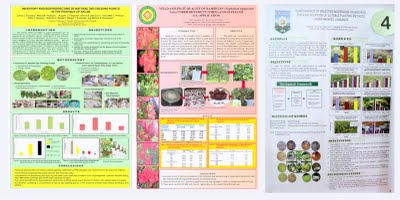
For poster category, Aklan State University’s presentation on “Inventory and Bioprospecting of Natural Dye-Yielding Plants in the Province of Aklan” and the “Yield and Fruit Quality of Rambutan under Different Timing and Levels of GA3 Application” won the first and the second prizes. CapSU’s work on the “Performance of Selected Indigenous Upland Rice through Adoption of Suitable Planting Methods under Rainfed Lowlands” was awarded third.

Winning posters (from left) from ASU and CapSU
Dr. Ma. Luisa Mabunay of the University of the Philippines (UP) Visayas; Dr. Ma. Cielito Siladan of the Forest Products Research  and Development Institute (FPRDI); and Dr. Lilian Diana Parreno of Guimaras State College (GSC) served as poster evaluators.

A number of evaluators were impressed with this year’s R&D outputs. Dr. Juanito Batalon, member of the planning, programming and packaging section of PCARRD’s crop research division, said the development papers, though few, most essentially addressed issues of preserving the environment while seeking to provide livelihoods to people.

Research panel (from left)
Dr. Rolando Labios,
Dr. Marcelino Siladan
and Engr. Flores
Dr. Marcelino Siladan, head of the program planning and packaging section of the Forest and Environment Division (FERD) of PCARRD, said that the winning research papers could very well compete in the national selection.

Among others, MS Ramon Peñalosa, meanwhile, took interest in CapSU’s banana chipper technology presented by Julito Albaladejo. For Peñalosa, such technologies can surely benefit small farmers and backyard technologies.

Most important, Engr. Rowen Gelonga, regional executive director of DOST 6, suggested that prior to their presentations of technologies during symposiums, the consortium should create an ad hoc committee to coordinate for Intellectual Property (IP) rights and issues. According to Gelonga, this is to safeguard the IP rights of inventors and their technologies and inventions.

The winning papers in the R&D categories will compete in the National Symposium on Agriculture and Resources Research and Development (NSARRD) to be hosted by PCARRD-DOST in November this year.


The development panel included (from left) Dr. Gilberto Altura;
MS Ramon Peñalosa, Jr;  Dr. Juanito Batalon
and Engr. Rowen Gelonga.
For his part, incoming Regional Research and Development Coordinating Council (RRDCC) chair, Dr. Joel Limson, president of the Northern Iloilo Polytechnic State College (NISPC) based in Estancia, Iloilo, warmly welcomed the participants in the symposium’s opening rites. Among others, Limson encouraged cooperation and teamwork among member agencies and which will benefit the consortium as a whole.

Hosted by CPU led by Dr. Reynaldo Dusaran, Techno Gabay Team Leader; Dr. Hope Patricio, RACG representative; and Aries Roda Romallosa, Regional Management Information Systems Group (RMISG) representative—this year’s 21st RSRDH was made possible through the efforts and initiative of the Consortium Secretariat and Dr. Geronimo Gregorio of CapSU, Regional Research and Development Group coordinator; Dr. Anna Mae Relingo of ASU, Regional Techno Gabay Group coordinator; Prof. Nilo Araneta of UPV who chaired the tabulation committee; and Dr. Jane Geduspan of UP Visayas and acting director and officer-in-charge of WESVARRDEC.


Participants, officials and facilitators of this year's RSRDH

Sunday, August 28, 2011

ASU hosts Visayas-wide forum on SUCs-private sector partnerships

By Sally R. Villasis

With reports from Rhea V. Martesano


The Aklan State University (ASU) hosted the Forum on SUCs (State Universities and Colleges)-Private Partnership on Education Economic Zones on August 17–19, 2011 at the ASU Review Center in Banga, Aklan.


The first in a series of four, the forum convened presidents, vice-presidents for academic affairs, vice-presidents for research and extension, vice-presidents for production and business of the SUCs and industry representatives from the three regions 6, 7 and 8, all of Visayas.


Led by the Commission on Higher Education (CHED) and the Philippine Association of State Universities and Colleges (PASUC), the said forum sought to provide venue for sharing the best practices on SUCs-Private Partnership and exploring potential partnerships with the private sector.


In his keynote address, Mr. Oscar A. Torralba, chair of the agri-business countryside development committee of the Management Association of the Philippines and CHED’s Technical Panel for Business and Management, presented the salient points of the Economic Education Zones (EEZ) as a Platform for Government-Industry-Academe (GIA) Public-Private Partnerships (PPP) among SUCs.


According to Torralba, SUCs today face intense competition for opportunities and priorities in fiscal allocation with threats of budget deficits and increasing demands by the globalized market. Therefore, it is imperative for SUCs to employ “innovative approaches in facing these harsh realities.” It was in this vein that EEZ was conceptualized.


EEZ is designed to transform an SUC from being traditional, budget-based and grant-driven into an enterprising institution which effectively exploits its natural resource endowments. Under the same approach, SUCs are encouraged to engage in the commercial application of their research and knowledge base and the strong participation of the private sector for long-term cooperation.


For her part, Dr. Virginia Resurreccion, director of CHED’s Regional Office 6, stressed on the importance of raising the country’s human capital to help address the global issue on poverty. For Resurreccion, there is a need for a curriculum that offers quality education and training of students who can compete in the global market and whose skills and expertise can match the emerging trends in the industry.


While these can be hindered by lack of economic resources or similar financial constraints, public and private partnerships can provide key mechanisms for flexibility and accommodate growth in SUCs. For one, newly conceptualized SUC curriculums could help create jobs and help spur economic growth.


According to Resurreccion, partnerships that can be forged between SUCs and private sectors can inspire SUCs themselves to focus on research, training and development. All these efforts can provide inexpensive offshoots to the growth of knowledge economy. Furthermore, partnering with the private sector can help address the need for financial support for SUCs’ R&D activities.


The Visayas-wide forum featured paper presentations on curricular enrichment and development, enterprise development, intellectual property management, technology business incubation and technology commercialization, business process outsourcing and infrastructure and physical facilities development.


ASU reaps awards in 21st R&D symposium

By Sally R. Villasis

Representative

Regional Applied Communications Group

Aklan State University


Three research studies of Aklan State University (ASU) won the top prizes in the 21st Regional Symposium on Research and Development Highlights (RSRDH) led by the Western Visayas Agriculture and Resources Research and Development Consortium (WESVARRDEC) on August 22, 2011 at the Central Philippine University in Iloilo City.


The “Inventory and Bioprospecting of Natural Dye-Yielding Plants in the Province of Aklan” won the top spot in the poster category and third place in the research category. The study was a joint effort of Lelisa Teodosio, Malco Teodosio, Rogelio Felizardo, Arlene dela Cruz, Anna Mae Relingo, Edito Agustin, Roberto Saladar, Margie Sumanga and Marilyn Romaquin of said university. Meanwhile, the “Yield and Fruit Quality of Rambutan under Different Timing and Levels of GA3 Application” by Marilyn Romaquin, Michael Ibisate and Eva Orlina won second in the poster category.


Collaborators of the winning research paper
share the award and recognition for ASU.


Other papers presented in the symposium were the “Inventory on Mangrove-associated Mollusks, Fish and Crustacean Species in ASU-CFMS Reforested Project at Isla Kapispisan, Pinamuk-an, New Washington, Aklan” authored by Regvil de Jose, Eduardo Pastrana and Ryan Basina, and “Sensory Evaluation of Processed Nipa Fruit for Product Development” conducted by Perlita Israel, Rino Andro Inocencio and Marivel Villorente.


Designed to provide venues for discussion of R&D projects and activities in the region and promote collaboration among its member agencies, WESVARRDEC’s 21st RSRDH sought to evaluate researches conducted by the different member agencies and promote interaction between and among


Award-winning posters from ASU

Saturday, August 27, 2011

21st RSRDH Winners

Winners in the 21st Regional Symposium on Research and Development Highlights

Henry Luce III Library, Central Philippine University, Jaro, Iloilo City

22 August 2011


RESEARCH CATEGORY


First Place

Development of Site-Specific Nutrient Management (SSNM) Recommendations for Irrigated Rice in Region VI by Greta Gabinete, Hector Pe
ñaranda, Benjamin Gutierrez and Roland Buresh


Second Place

Field Testing of ICRISAT Legume Varieties and Technologies in Selected Regions of the Philippines by Corazon Arroyo and Nenita Sodusta, Department of Agriculture-Western Visayas Integrated Agricultural Research Center


Third Place

Inventory and Bio-prospecting of Natural Dye-Yielding Plants in the Province of Aklan by Marilyn Romaquin, Lelisa Teodosio, et.al., Aklan State University


Evaluators

Dr. Rolando Labios, DA-BAR

Dr. Marcelino Siladan, PCARRD

Engr. Emelyn Flores, DOST 6


DEVELOPMENT CATEGORY


First Place

Bio Power-up Fuel Additive by Paolo Petalver and Dioscoro Marañon, Jr. of West Negros College-Research and Development Foundation, Inc.


Second Place

Low-Density Biomass Charcoal Maker by Paolo Petalver and Dioscoro Marañon, Jr. of West Negros College-Research and Development Foundation, Inc.


Third Place

SPD Multi-function Food Processing Equipment by Paolo Petalver and Dioscoro Mara
ñon, Jr. of West Negros College-Research and Development Foundation, Inc.

Evaluators

Mr. Ramon Peñalosa, Jr., MS, WESVARRDEC

Engr. Rowen Gelonga, DOST 6

Dr. Juanito Batalon, PCARRD

Engr. Gilberto Altura, NEDA 6


POSTER CATEGORY


First Place

Inventory and Bioprospecting of Natural Dye-Yielding Plants in the Province of Aklan, Aklan State University


Second Place

Yield and Fruit Quality of Rambutan under Different Timing and Levels of GA3 Application, Aklan State University


Third Place

Performance of Selected Indigenous Upland Rice through Adoption of Suitable Planting Methods under Rainfed Lowlands, Capiz State University


Evaluators

Dr. Ma. Luisa Mabunay, UP Visayas

Dr. Ma. Cielito Siladan, FPRDI

Ms. Lilian Diana Parreño, GSC


Thursday, July 21, 2011

“Better ASU researches this year”–PCARRD

By Lelisa J. Teodosio, RMIS Representative

and Sally R. Villasis, RACG Representative

Aklan State University

Photos from PCARRD ACD


The quality of research in Aklan State University (ASU) is much better than it was two or three years earlier.


This is according to Dr. Lily Ann Lando, director of the Applied Communication Division (ACD) of the Philippine Council for Agriculture, Forestry and Natural Resources Research and Development (PCARRD) who delivered her speech in the closing rites of the ASU In-house Review on July 14–15, 2011 at the ASU Review Center, Banga, Aklan.


Commending ASU for hosting the “very important event,” Lando (see photo) likewise urged the researchers to continue to do research because ASU has a “big responsibility for being a Regional University.” According to Lando, researchers must lead the way not only for the ASU community but also for their colleagues in the region’s other universities.


ASU led the in-house review this year to mainstream its programs towards agriculture and fishery. The conference convened researchers from ASU’s five campuses who presented a total of 45 research papers. Of these, five are ongoing, 24 are proposed while 16 have already been completed.


Cited best papers for agri-fishery and eco-tourism were the “Inventory and Bioprospecting of Natural Dye-Yielding Plants in the Province of Aklan” presented by Arlene Dela Cruz, et.al.; “Yield Performance of Pummelo var. Helmar as Affected by Pruning and Different Source of Fertilizer” by Michael Ibisate, et.al.; and “Resource Assessment of Brackish Rivers of New Washington, Aklan” by Zaida Ochavo, et.al.


Under the education, socioeconomics and related fields, the best papers were “Perception and Acceptance of Fingerprint Biometric Technology among Teaching and Non-Teaching Personnel of ASU: Basis for Policy Recommendation” by Alfonsa Fanie Radislao, et.al.; “Learning Strategies of BSEd 3 Students in English Language Proficiency as a Second Language” authored by Librada Rebustes, et.al.; and “Leadership Dimension among Deans and Directors of Aklan State University: Its Implications to Public Administration.”


Dr. Anna Mae Relingo, officer-in-charge of the Office of the Vice-President for Research and Extension of ASU said that “what makes a university is its research. And so to sustain further improvement of the quality of researches in the University, we hosted the in-house review.” Relingo also acts as Regional Techno Gabay Coordinator of the Western Visayas Agriculture and Resources Research and Development Consortium (WESVARRDEC).


Featuring the expertise of the University’s partner institutions, ASU invited selected panel evaluators to help enhance the research and development initiatives of the University.


For agri-fishery and eco-tourism, the panelists were Dr. Lily Ann D. Lando; Mr. Rolando V. Labios, chief agriculturist and coordinator for research office of the Director of the Department of Agriculture-Bureau of Agricultural Research (DA-BAR) and Dr. Ulysses M. Montojo, senior aquaculturist and in-charge of planning, monitoring and evaluation division of DA-National Fisheries Research and Development Institute.


The same panel included WESVARRDEC Director Joseph Edward O. Idemne who was represented by Dr. Geronimo L. Gregorio, vice-president for research and extension of the Capiz State University (CapSU) and coordinator of WESVARRDEC R&D Group; and Dr. Jonic Natividad, regional veterinary quarantine officer of DA-Regional Field Office 6.


For education, socioeconomics and related fields, the evaluators were Dr. Evelyn L. Gregorio, faculty of CapSU Graduate School and social science researcher; Ms. Andrea Panilla, senior science research specialist of the Department of Science and Technology (DOST) 6; and Dr. Ersyl T. Biray, vice-president for academic affairs of ASU.


For his part, ASU President Danilo E. Abayon said that “we can do something after several years of inculcating the need to conduct research by the faculty.” For Abayon (see photo), it is also good to see that the University is getting mature in terms of the conduct of research. In his first year as president, Abayon stressed that researchers should publish in international journals, as they have already gone through national and international presentations.


Abayon also cited that researchers ought to revive many centers in the University such as the Center for Productive Use of Renewable Energy. He also encouraged to launch operations of the biodiesel plant and establish partnership with DOST for the Natural Dye Technology Resource Center. Abayon also urged everyone to sustain many other projects geared towards the improvement of the University’s R&D and extension programs.


CHSMC hosts 1st SK Kampo Kalikasan

By Jethro B. Dagunan

Representative

Regional Applied Communications Group (RACG)

Carlos Hilado Memorial State College


“To contribute to the worldwide efforts of mitigating problems and issues on our environment,” the Carlos Hilado Memorial State College (CHMSC) Fortune Towne Campus led the environmental youth camp dubbed as the first Sangguniang Kabataan (SK) Kampo Kalikasan June 1, 2011 at the University of Saint La Salle (USLS) Eco-park in Barangay Granada, Bacolod City.


Themed “Dare to be Different,” Kampo Kalikasan was organized by the Students’ Actions Vital to the Environment and Mother Earth Movement or (SAVE ME Movement) of the CHMSC Fortune Towne Campus with the leadership and support of Barangay Estefania SK chaired by Karen P. Villarosa.


A national organization registered at the Securities and Exchange Commission (SEC), SAVE ME Movement was named Ten Accomplished Youth Organization Awardee in 2006 and one of the Top Ten Youth Outstanding Organizations in the Philippines in 2003.


Attended by some 70 youth participants from Barangay Estefania, the Kampo Kalikasan is one the strategies launched as a response to the research findings conducted Dr. Ma Teresita Ballados. Ballados’s study found that the residents of Bacolod City have poor solid Waste Management (SWM) practices. SWM includes waste segregation, collection and transport, disposal and recycling.


Sampling some 269 respondents from Barangay 10, Barangay 19, Sum-ag and Estefania, all of Bacolod City, said study found that waste disposals are rampant in the streets, rivers and open sewerage.


After Dr. Eduardo G. Sayson, executive director of CHMSC Fortune Towne, opened the program, Mr. David G. Castor of the Negros Forest and Ecological Foundation (NFEF, Inc.) provided participants a national situationer, stressing on the present condition of the Philippine biodiversity.


Castor also shared on the importance of environmental education to help increase environmental awareness among constituents and to facilitate social programs and projects to maintain a sustainable and environmentally friendly community.


Prof. Jethro B. Dagunan of CHMSC lectured on climate change and the phenomenal causes of the problem and concrete possible solutions as regards solid waste management under Republic Act No. 9003.


After the youth camp, the CHMSC Fortune Towne, spearheaded by the SAVE ME Movement, will organize the Barangay Estefania Youth who are envisioned to become movers of the possible solutions of the SWM problem implementation and disaster risk mitigation in Bacolod City.


Friday, July 01, 2011

German org awards SWM4LGUs training modules to CPU

By Hope Patricio

Representative

Regional Applied Communications Group

Central Philippine University


The Central Philippine University (CPU) led by President Dr. Teodoro Robles officially received the Training Modules for the Solid Waste Management for Local Government Units (SWM4LGUs) from the Deutsche Gesellschaft für Internationale Zusammenarbeit (GIZ)-AHT Group AG headed by its Team Leader Dr. Johannes Paul on June 23, 2011 at the Appropriate Technology Center of the College of Agriculture, Resources and Environmental Sciences (CARES) in Jaro, Iloilo City.


A highlight of GIZ-CPU cooperation in jointly pioneering a university curriculum in resource management, the handover of said materials was witnessed by Engr. Marivic Ricaña, deputy team leader of GIZ-AHT’s SWM4LGUs Project; Engr. Voltaire Acosta, National Solid Waste Management adviser of GIZ-AHT; Engr. Klaus Hanuschke, GIZ consultant for CPU SWM project; Dr. Reynaldo Dusaran, dean of CARES; Engr. Aries Roda Romallosa, agricultural engineering coordinator of CARES; and Prof. Hope Patricio, research Coordinator of CARES.


The CPU officials received 17 training modules which will be used as lecture materials for the diploma program on resource management major in solid waste management under CARES. Said program would be offered to solid waste management (SWM) practitioners to enhance their expertise and to help produce new professionals in the SWM sector.


A project of GIZ's AHT GROUP AG, a privately owned independent consulting firm that offers management and engineering services in water, agriculture, environment, governance and waste, SWM4LGUs can be found in many areas across the country including Iloilo City, Roxas City and Buenavista in Guimaras in Western Visayas.


CPU President Teodoro Robles (third from left)

receives the materials from Dr. Johannes Paul

of GIZ-AHT (second from left),

as witnessed by the officials of the two institutions.


Related Posts Plugin for WordPress, Blogger...

Printfriendly